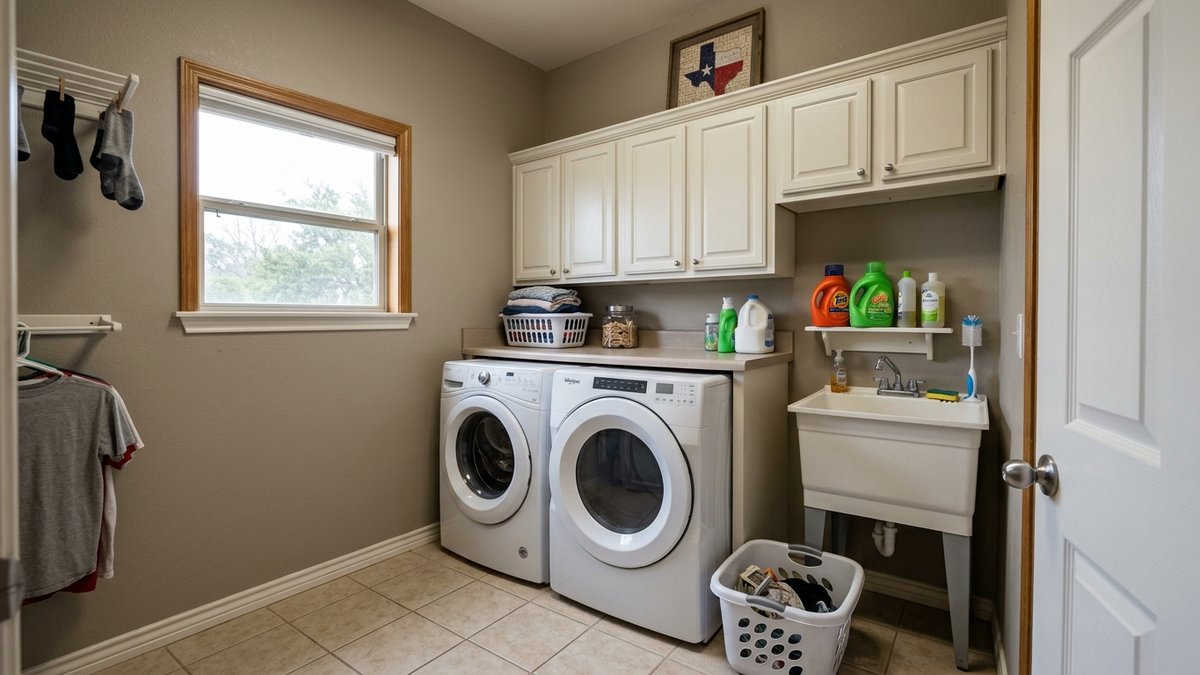
Will your washer and dryer fit the space?
Check the space against the exact appliances you plan to use. A New Braunfels listing photo may show a washer and dryer sitting neatly behind closed doors. That does not establish that a different pair can be installed, connected, loaded, or serviced in the same space.
At the showing, note the width of the opening, the usable depth, and the height available above the machines. A visible gap is useful information, but it is not a complete installation measurement. Connections, hoses, exhaust arrangements, trim, and door tracks can affect the space an installer needs.
Ask for the installed machines’ model numbers and any available manuals. If you plan to bring your own appliances, use those model numbers too. Compare the manufacturers’ installation instructions with the actual closet rather than relying on a general appliance size.
Also separate the appliances from the home. Ask your agent to help clarify which machines are included in the transaction and which are only present for the showing. Treat that as a question to resolve through the appropriate documents, not an assumption based on the photo.
Stacking deserves a separate check. Do not assume that two machines can be stacked because their widths look similar. Ask the manufacturer or a qualified installer about the exact pair and any required hardware. Reach the controls and loading areas in the arrangement you expect to use.
Pete’s buyer services page can help you organize these questions with the wider home comparison. A compact laundry space can work well when the specific equipment and access fit. Record what is confirmed and what still depends on an installer’s assessment.
Can you load the machines without blocking the room?
Look at the laundry area with the closet doors and appliance doors open. The daily question is whether you can load, unload, and carry a basket without working around a conflict. The space can look completely different once the doors move into their working positions.
With permission, open the ordinary doors without operating the equipment. Note whether a closet panel covers an appliance handle, a dryer door reaches into a hallway, or a basket would have to sit in a passage. Do not force a door that binds or move the machines to create clearance.
Then follow the route you would use for laundry. Start where clothing would be collected, walk to the machines, and picture carrying the finished load back. Check turns, stairs, and nearby doors that affect that route. This is a household fit exercise, not a finding that the home has a defect.
Think about where sorting and folding would happen. A closet may leave those tasks to a nearby room. That can be a workable arrangement, but it deserves a plan. Cabinets above the machines do not automatically provide a useful place for a basket or a reachable folding surface.
If more than one person uses the space, compare what happens when someone passes while another person loads the washer. A location beside a main hallway has different practical limits from a closet reached through a utility area.
Write down the conflict that would bother you most. A door swing you can comfortably work around may be acceptable. A route that depends on moving a machine or changing a wall belongs in a separate project assessment before you treat it as solved.
What kind of dryer is installed in the closet?
Identify the actual dryer before judging its exhaust arrangement. A conventional vented dryer and a heat pump dryer handle moisture differently. A missing exterior exhaust connection can mean different things depending on the equipment, so start with the model and its installation instructions.
ENERGY STAR’s heat pump dryer guide explains that heat pump dryers reuse air in a closed loop and remove moisture without a conventional dryer vent. They still produce collected water that needs to be managed. The guide describes tank emptying and drainage arrangements as possible approaches.
That national guidance explains a dryer type. It does not prove that a particular closet in New Braunfels is ready for one. Ask a qualified installer to compare the proposed model’s requirements with the available space, electrical setup, and water-management arrangement.
For a vented dryer, ask where the exhaust goes and whether its condition and access can be checked. The U.S. Fire Administration’s dryer safety guidance recommends professional installation and service. It also calls attention to venting that is damaged, crushed, or restricted.
A showing gives you limited visibility. A connector behind a machine may be hidden, and a wall opening does not reveal the whole exhaust route. Ask the inspector to describe what can be observed and what needs a specialist or installer to review.
Keep the current setup and a replacement plan separate. A buyer who intends to change dryer types needs an answer for the proposed machine. The fact that the seller’s dryer operates does not establish that your planned replacement can use the same arrangement.
Is there enough access for routine care and service?
Check whether you can reach the parts that the machine’s instructions require you to maintain. A closet is easier to assess when you think beyond loading clothes. Ask how the lint filter, controls, water collection, and other model-specific maintenance points are accessed.
The U.S. Fire Administration advises cleaning the dryer’s lint filter before and after each cycle. Its guidance also addresses lint that can build up behind the dryer and the condition of the venting system. Those recommendations make maintenance access a useful buyer question.
If a filter or water tank is difficult for you to reach, note that practical limit. Do not remove covers or attempt a service procedure during a showing. Ask the seller about the normal care routine and request the manual so you can understand the equipment without guessing.
Also ask how a service professional would reach the machines and connections. A narrow door or a fixed shelf may complicate access even when the appliances fit inside. An installer can assess whether the arrangement works for the exact equipment and what a replacement would require.
For electrical safety, the U.S. Fire Administration’s appliance guidance advises plugging major appliances directly into wall outlets and avoiding extension cords. Ask a qualified electrician about a questionable connection instead of treating an improvised setup as a ready solution.
Look at visible surfaces without assigning a cause. Marks near the washer, damaged trim, or an unusual odor are questions for an inspection, not enough information to diagnose a leak or moisture problem. Pete’s home inspection questions guide provides broader context for organizing observations and follow-up questions.
Which questions need an answer before you rely on the setup?
Separate confirmed fit, everyday preferences, and installation questions. A laundry closet does not need to look like a separate laundry room to be useful. It does need to support the equipment and routine you are counting on.
Use this checklist at each New Braunfels home so you compare the same points:
| Check | Record at the showing | Who can clarify the open question? |
|---|---|---|
| Appliance identity | Installed and planned model numbers | Manufacturer or qualified installer |
| Loading access | Closet and appliance door movement | Buyer fit review or installer for proposed changes |
| Dryer type | Vented or heat pump, as documented | Installer or appropriate professional |
| Maintenance access | Reachable filter and other care points | Manufacturer instructions and service professional |
| Replacement plan | Space or connection changes still needed | Qualified installer or contractor |
If the space works as it is, record why. If your decision depends on a different appliance pair, treat that change as an unresolved part of the purchase comparison. An installer’s written assessment is more useful than assuming a compact model will solve every issue.
Ask for available installation and service records, but keep their purpose clear. Records help identify the equipment and work performed. They do not certify the present condition of every hose, connection, or hidden exhaust component.
Avoid assigning a fixed upgrade cost to the closet. The current information does not establish a local price for new appliances, installation, electrical work, or changes to the opening. Get estimates for the actual scope if that work affects your choice.
Pete’s home buyer’s guide offers context for the broader purchase process. Bring the model information, measurements, and unresolved questions to the professionals reviewing the home. Decide whether the laundry setup works today or depends on a change that still needs verification.